
Stop Blaming Kubernetes for Your Cloud Bill
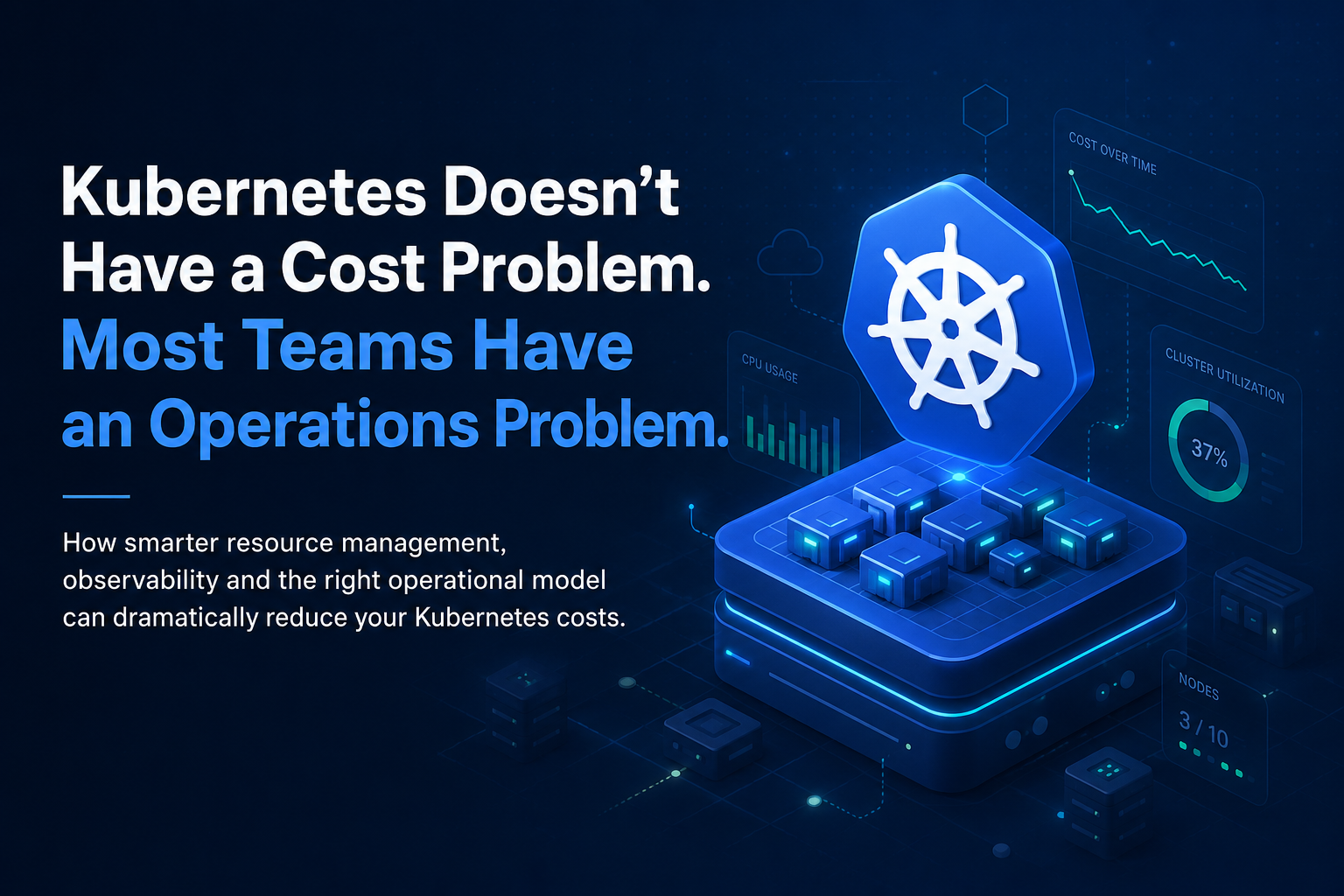
When cloud costs increase, Kubernetes is often one of the first technologies to be blamed.
The reasoning seems obvious. Kubernetes adds another layer of complexity, requires dedicated infrastructure and introduces concepts like autoscaling, worker nodes and container orchestration.
But after looking at enough production environments, a different picture emerges.
Most expensive Kubernetes clusters aren't expensive because of Kubernetes.
They're expensive because of how they're operated.
Oversized resource requests, inefficient scheduling, low node utilization and fragmented cluster architectures quietly increase infrastructure costs long before anyone notices.
Resource Requests Matter More Than Most Teams Realize
Kubernetes schedules workloads according to the resources applications request—not according to what they actually consume.
That's an important distinction.
Developers often configure conservative values to avoid performance problems during peak traffic.
The application may request four CPU cores while rarely using even one.
The same happens with memory.
Individually, these decisions seem harmless.
Across hundreds of workloads, they leave large portions of the cluster reserved but unused.
Infrastructure appears fully allocated despite having significant spare capacity.
Bigger Clusters Don't Always Solve Bigger Problems
When utilization appears high, many organizations simply add more worker nodes.
This temporarily removes scheduling pressure but doesn't improve efficiency.
The underlying issue remains unchanged.
Adding infrastructure should be the last step—not the first.
Before expanding a cluster, platform teams should verify whether workloads are correctly sized, whether nodes are balanced efficiently and whether idle capacity already exists.
In many environments, better resource management delivers greater savings than additional hardware.
Metrics Should Drive Every Infrastructure Decision
Successful Kubernetes operations rely on data rather than assumptions.
Engineering teams should always know:
Which services consume the most resources?
Which deployments rarely use their requested CPU?
Which nodes consistently remain underutilized?
Where is CPU throttling affecting application performance?
Which workloads restart unexpectedly?
Without comprehensive monitoring, optimization becomes little more than educated guessing.
Platforms such as Prometheus and Grafana have therefore become essential parts of every production Kubernetes environment.
Autoscaling Is Only Part of the Picture
Autoscaling is incredibly useful—but only when the underlying platform is already efficient.
Horizontal Pod Autoscaler adjusts replica counts.
Vertical Pod Autoscaler improves resource recommendations.
Cluster Autoscaler manages worker nodes.
None of them correct inaccurate workload configurations.
If applications request significantly more CPU or memory than necessary, autoscaling simply increases the cost of an already inefficient environment.
Simplifying Kubernetes Operations
As Kubernetes adoption grows, another challenge often appears.
Operational complexity.
Additional clusters are created for different environments, customers or business units until platform engineers spend more time maintaining infrastructure than supporting development teams.
Many organizations are now moving toward consolidated Kubernetes platforms with strong namespace isolation, RBAC policies and centralized operations.
This reduces maintenance effort while preserving security and flexibility.
The Value of Managed Kubernetes
Operating Kubernetes successfully requires far more than deploying a cluster.
Control plane maintenance, upgrades, monitoring, security, networking and backup strategies all require ongoing operational expertise.
Managed Kubernetes allows engineering teams to continue using the same Kubernetes ecosystem—Helm, kubectl, GitOps and modern CI/CD workflows—while leaving platform operations to experienced specialists.
Organizations looking for enterprise-ready Kubernetes hosted within European data centres can learn more about vshosting Managed Kubernetes here:
Managed Kubernetes: Skalierbare & Sichere Orchestrierung - vshosting~
Don't Forget the Infrastructure Beneath Kubernetes
Container orchestration is only one layer of the stack.
Reliable enterprise infrastructure remains equally important.
Fast NVMe storage, resilient networking, enterprise hardware and predictable performance directly influence how Kubernetes workloads behave in production.
Businesses requiring dedicated infrastructure for Kubernetes and other critical workloads can find more information about vshosting Private Cloud at:
Private Cloud: Höchste Sicherheit & Kontrolle - vshosting~
Conclusion
Kubernetes isn't inherently expensive.
Poor operational decisions are.
Companies that continuously monitor workloads, right-size resource requests and simplify platform management frequently reduce costs without reducing performance.
In many cases, the goal isn't building larger Kubernetes clusters.
It's operating smarter ones.
Discover more about managed infrastructure, enterprise cloud services and Kubernetes hosting at:

